
How many times have you looked for that one story you know your favorite creator saved, somewhere between her hundred highlights? Creators move a half-trillion-dollar economy through these stories, and there is still no search.
The decade of influencers
Goldman Sachs sizes the creator economy at $250B today, headed toward ~$480B by 2027. Almost 40% of Gen Z already searches on TikTok and Instagram instead of Google. A creator’s profile is a store, a travel guide, a recipe book. And Instagram keeps its only permanent archive in a row of tiny circles.
The problem
Stories die after 24 hours. Highlights are the only public archive, but there’s no search. Followers scroll circles, give up, or DM the creator, who answers “which hotel in Corfu?” for the fiftieth time. TikTok already shipped profile search. Instagram offers archive search to the account owner only.
I was looking for one specific recipe. It took me a year to find it.
I went back to her highlights to find it, but there were so many I just gave up. I'm sure a search feature would have solved it.
I searched for barely a minute. It wasn't accessible, so I gave up on the information.
A 2026 note on my 2025 methodology: “would this be useful?” is a leading question, and today I’d cut it. The evidence I actually trust here is behavioral: 84% had already tried to find something in someone’s highlights, most gave up, and the stories they told are specific. Intent inflates. Behavior doesn’t.
n=32 · self-run survey · January 2025 · quotes translated from Hebrew
Feel it yourself
This profile has 40 highlights. Somewhere in there is a gelato place in Rome. Go find it.
The phone is live. Scroll the circles. We’ll time you.

January 2025 · the research
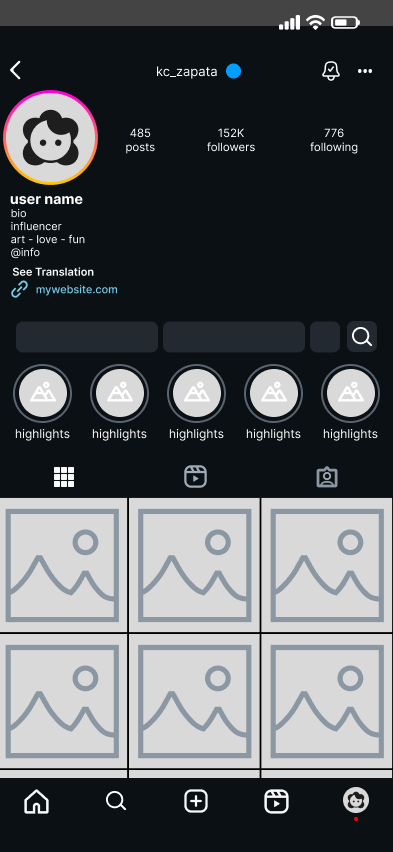
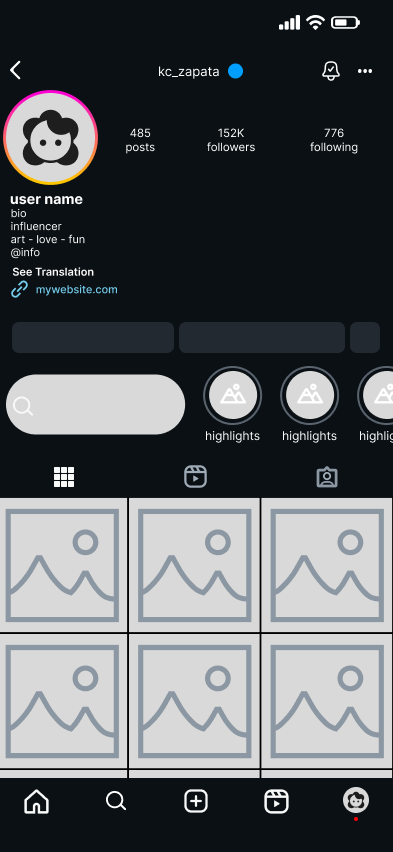
The first pass lived in Figma: two entry points, pixel-copied Instagram frames, and the survey above. Static mockups answered where search could sit, but not the question that decides a search product: how finding actually feels. Nobody can type into a mockup.
The prototype · search that works
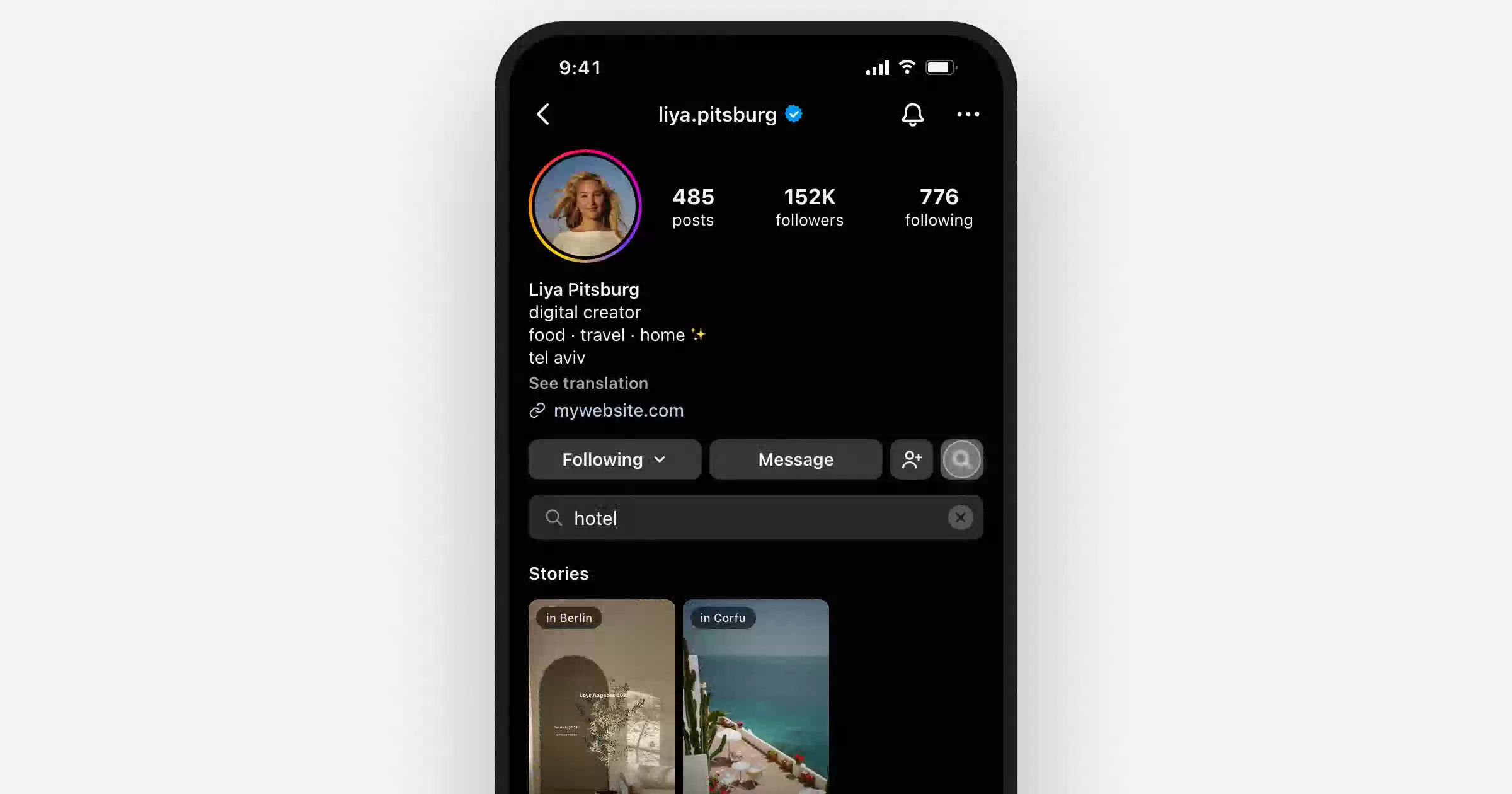
So the second pass is alive: a faithful Instagram replica with a working search engine behind it. Tap the little search button next to Message. Type hotel. Type pesto. Type קורפו. The search is bilingual, because in 2026 a search index understands meaning, not strings.
The nesting rule
The hard design question isn’t where the button goes. It’s what a result is. Search “Berlin” and you want the whole trip. Search “iHerb” and you want one specific story inside Coupons. The rule the prototype runs on: a match on the name returns the collection; a match on the content returns the story, with its highlight as a breadcrumb. Sectioned results, like Spotify. Never a tree.
Two ways in
Entry point A: a search action next to Message, sized like the buttons Instagram already has. The smallest possible change, shippable tomorrow. Entry point B: highlights promoted to a full profile tab, where the archive finally behaves like a library. I’d ship the button first and grow into the tab. The 2025 survey already pointed there: half wanted search prominent, above the row.
Why hasn’t Instagram built this?
Steelmanning the other side: stories were born ephemeral, indexing billions of them costs real money, and a feed optimized for time-on-app has little incentive to help you leave faster. But the signals already exist: location stickers, link stickers, auto-captions. The first platform to connect them turnsevery creator’s archive into a store. The metrics I’d watch: time-to-find, search success rate, taps on old link stickers, and fewer “where’s that hotel?” DMs.
Prototype: Next.js · Tailwind · Framer Motion · built with Claude. Liya Pitsburg is fictional; every image was AI-generated for this concept. Not affiliated with Instagram. Original exploration: Figma + survey, January 2025.
Open the full prototype ↗Live prototype — it responds to the story, and to you